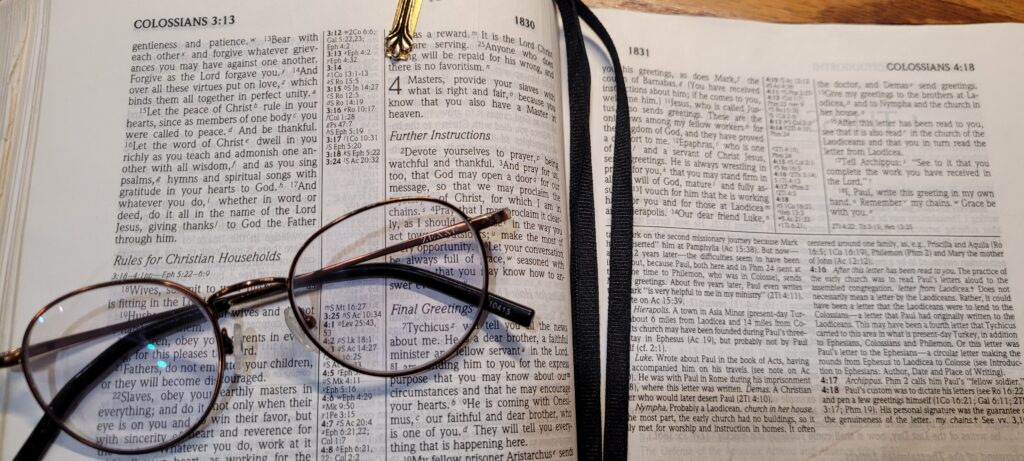
One of the hallmarks of Lutheranism is the encouragement of all Christians to be in the Word of God, reading and studying it themselves, not simply being content to have “the church” tell them what it says or what it means. Luther translated Scripture into the language of his people for that very reason.
I think people need to be reminded of that on a regular basis. The first president of our church body, C.F.W. Walther, did just that in a book entitled “From Our Master’s Table.” He spoke of the importance of lay people who know and study God’s Word (Acts 17:11, 1 Peter 3:15-16).
“Teachers must not rule over the consciences of their hearers and hearers must not follow their teachers like blind puppets. In the church there must be no spiritual masters. The knowledge of the mysteries of the religion must not be a monopoly of a special class of people, a priestly caste. Every Christian must wear the Urim and the Thumim of truth upon his chest as a spiritual priest. The layman himself must also, therefore, delve into the Scripture, draw out of the well and, by his own freely being convinced, believe, without building on human authority; he must not, like an inanimate machine, say, as did that coal merchant: “I believe what the “church believes,” without having learned, tested and proven the faith of the church. The layman must be sure of his relation to God without human, priestly mediation and be able to speak and give answer for himself for the hope that is in him, without having to call upon the better insight of his teacher. Yes, the laity must be fit and always become more competent to judge the doctrine of his teacher, to distinguish the truth from heresy and, thus, to keep watch over those who watch over him. Christians must be children with respect to evil but mature in their understanding. Only when the church is so established does she have the form which her eternal founder has given her, who said: “Therefore, only one is your Master, Christ. But you are all brothers.” That is why the prophet had foretold of the church of the New Covenant: “No one will teach another, but they will all be taught by God, both small and great.” (Jeremiah 31.34; John 6.45)”
I grew up with that encouragement. The church is stronger when we are in God’s Word. One of the prayers that has been used regularly in our worship services is known as “The Collect for the Word.” This is how it appears in “The Lutheran Hymnal” from 1941.
Blessed Lord, who hast caused all Holy Scripture to be written for our learning, grant that we may in such wise hear them, read, mark, learn and inwardly digest them, that by patience and comfort of Thy holy Word we may embrace, and ever hold fast, the blessed hope of everlasting life, which Thou hast given us in our Savior Jesus Christ, who liveth and reigneth with Thee and the Holy Ghost, ever one God, world without end. Amen.
Lord, help us to truly be people of Your Word.