revmattil.org

Devotions to help you Think about God’s Word and Apply it to your Lives.

About revmattil

This author has not yet filled in any details.
So far revmattil has created 1240 blog entries.

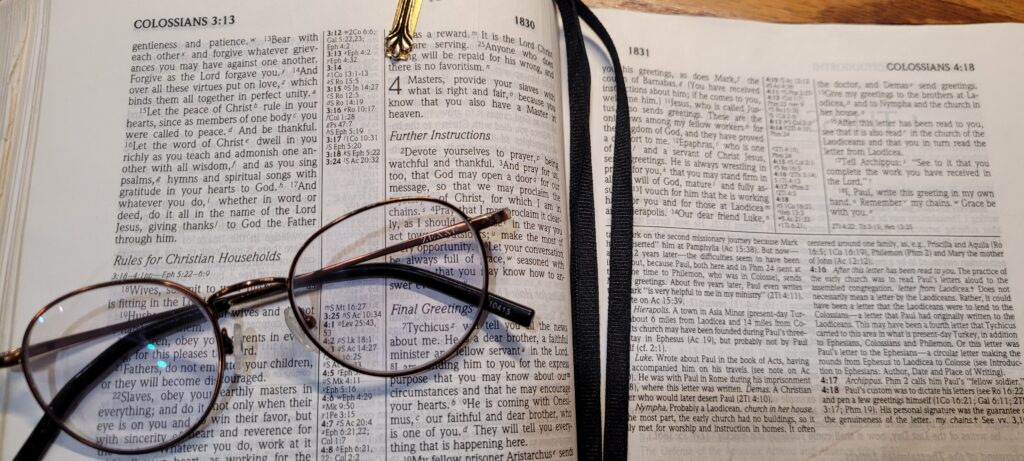
My Eyes

Scripture speaks of Moses reaching the end of his time here on earth without the disability of poor eyesight.

Deuteronomy 34:7 Moses was a hundred and twenty years old when he died, yet his eyes were not weak nor his strength gone.

I am not like that. I’m more like the descriptions of Isaac and Eli.

Genesis 27:1 When Isaac was old and his eyes were so weak that he could no longer see…

1 Samuel 3:2 One night Eli, whose eyes were becoming so weak that he could barely see…

Well, I’m not quite that bad, but seven years ago in January I had a torn retina in my left eye and a torn and detached retina in my right eye. It was not the result of an injury, but something hereditary. My father had something very similar happen to him.

My left eye was repaired with non-invasive laser surgery, and has been doing very well. The right eye, however, required more aggressive surgery to repair it. They put a buckle around it, removed the fluid from inside my eye and tried to weld the detached retina back into place with lasers. They then filled the eye with an oil to try to hold everything in place. Another surgery removed the oil, and I was hopeful that would be the end of that. At my next checkup, they discovered a wrinkle in the retina, so I went through everything again. I was closely monitored for many more months, during which time they removed the cataract from my right eye, which was caused by all the surgeries. In November they determined that the retina was still not attached properly, so I went through the entire procedure a third time. They were very aggressive with the laser and finally successful in attaching the retina. Unfortunately, the consequence of all those surgeries is very blurry vision in my right eye, so much so that I cannot see anything other than the big E on the eye chart with that eye. Thankfully, my left eye has enabled me to live a “normal” life.

However, for the last three or four years a cataract has been forming in my left eye. My ophthalmologist is a friend of mine, and has been monitoring it closely. He is known as a top-notch cataract surgeon, but has been putting this off as long as possible. Why? He told me the main risk in cataract surgery is a detached retina. Because I only have one good eye, he didn’t want to do it until it was necessary.

The time has come. My night vision is nothing but starbursts when there are lights. The retina doctor has cleared me for the surgery, which is taking place today.

I’m sharing this with you so that you might offer a prayer for me and those who will be working on me. I have complete confidence in my surgeon. He has already performed cataract surgery on both of Cheryl’s eyes. I will be praying with him today before the surgery. I do so with the assurance that God is the one in control of all this.

A passage I often shared with others as they faced surgery is the one below.

Psalm 31:9–15a Be merciful to me, O Lord, for I am in distress; my eyes grow weak with sorrow, my soul and my body with grief. My life is consumed by anguish and my years by groaning; my strength fails because of my affliction, and my bones grow weak. Because of all my enemies, I am the utter contempt of my neighbors; I am a dread to my friends— those who see me on the street flee from me. I am forgotten by them as though I were dead; I have become like broken pottery. For I hear the slander of many; there is terror on every side; they conspire against me and plot to take my life. But I trust in you, O Lord; I say, “You are my God.” My times are in your hands.

My times are in the hands of the one who lived and suffered and died and rose again for me. He has provided for my greatest need: forgiveness. He has blessed me beyond anything I deserve. I trust Him in all things. I know that I could not be in any better hands.

It may be a few days before I write another devotion.

My Eyes2023-03-22T10:56:18-05:00

Conversations

I have a 4 year old grandson – Simon – that is quite a character. He has the ability to immerse himself in things totally. He gets a lot of joy out of just being a kid. His wide range of facial expressions crack me up. But he can also be a little pill at times. On a recent trip, we were on a hiking trail with him, his sister and his parents. At one point, he was tired of hiking and started whining, complaining and misbehaving. His dad told the rest of us to go ahead so he and Simon could have a “conversation.”  They caught up to us a few minutes later. Simon was not happy, but was behaving himself better after their “conversation.”

Later that day, at the dinner table, Simon was acting up a bit again, and his dad asked, “Do you and I have to have another conversation?” Simon looked down and said in a whiny voice that was loud enough for everyone to hear, “I hate conversations!”

Can you relate? None of us likes to have our misbehavior pointed out to us. The Law shows us our sin, and we don’t like to hear that we have done wrong. But when we are whining and complaining and misbehaving, we need to have that “conversation” with God. We go astray over and over again. We need the clear word of God’s Law to show us our failures, our shortcomings, our misbehavior. We need to be made conscious of  our sin.

Romans 3:20 Therefore no one will be declared righteous in his sight by observing the law; rather, through the law we become conscious of sin.

Having been convicted of our sin, we can appreciate just how wonderful the Gospel message is. The law prepares us to hear the Good News of Jesus as our Savior.

Romans 3:21–28  But now a righteousness from God, apart from law, has been made known, to which the Law and the Prophets testify. This righteousness from God comes through faith in Jesus Christ to all who believe. There is no difference, for all have sinned and fall short of the glory of God, and are justified freely by his grace through the redemption that came by Christ Jesus. God presented him as a sacrifice of atonement, through faith in his blood. He did this to demonstrate his justice, because in his forbearance he had left the sins committed beforehand unpunished—he did it to demonstrate his justice at the present time, so as to be just and the one who justifies those who have faith in Jesus. Where, then, is boasting? It is excluded. On what principle? On that of observing the law? No, but on that of faith. For we maintain that a man is justified by faith apart from observing the law.

Lord, thank you for being the loving Father that has the “conversations” with me that I need to hear. Not only do you point out my sin, but you also point out my Savior. Keep my eyes focused on Him. In His name I pray. Amen.

Conversations2023-03-20T16:29:33-05:00

Prayin’ Time

At the worship service I attended yesterday the preacher was in the middle of a sermon series on spiritual disciplines. The topic of the day was prayer. At one point, he said something along the lines of “we should pray in the morning, we should pray in the evening, we should pray at meals…”  When he said that, I had a silly thought. I was reminded of a song made popular by the McGuire sisters the year I was born, Sugartime.

Sugar in the mornin’
Sugar in the evenin’
Sugar at suppertime
Be my little sugar
And love me all the time

Honey in the mornin’
Honey in the evenin’
Honey at suppertime
So be my little honey
And love me all the time

1 Thessalonians 5:17 pray continually

That little love song might be a reminder to talk to our heavenly Father regularly.

Prayin’ in the mornin’
Prayin’ in the evenin’
Prayin’ at suppertime.
Talk to God the Father
Who loves you all the time.

We have the awesome privilege of being able to speak to the one in control of everything with the assurance that He hears and listens to us for Jesus’ sake. He has shown His tremendous love to us by giving His one and only Son to be our Savior and pay for the sins of the world, so that everyone who believes in Him does not hae to perish but can have eternal life. Jesus earned that for everyone, and all who trust His promise receive the benefit of what He did.

In addition, we know He is listening.

1 John 5:14 This is the confidence we have in approaching God: that if we ask anything according to his will, he hears us.

Matthew 21:22 “If you believe, you will receive whatever you ask for in prayer.”

Prayin’ Time2023-03-20T07:12:08-05:00

Come to Calvary’s Holy Mountain

This Sunday’s Lenten Hymn for your reflection.


Come to Calv’ry’s holy mountain, Sinners ruined by the Fall;
Here a pure and healing fountain Flows to you, to me, to all.
In a full, perpetual tide, Opened when our Savior died.

Come in poverty and meanness, Come defiled without, within;
From infection and uncleanness, From the leprosy of sin,
Wash your robes and make them white; Ye shall walk with God in light. 

Come in sorrow and contrition, Wounded, impotent and blind;
Here the guilty free remission, Here the troubled peace may find.
Health this fountain will restore; He that drinks shall thirst no more.

He that drinks shall live forever; ‘Tis a soul renewing flood.
God is faithful, God will never Break His covenant of blood,
Signed when our Redeemer died, Sealed when He was glorified.

 (The Lutheran Hymnal #149)

Come to Calvary’s Holy Mountain2023-03-08T19:21:14-06:00

What Do You Think of Yourself?

Sometimes we think more highly of ourselves than we should. Jesus warned against this is the parable of the Pharisee and the Tax Collector (Luke 18:9-14). Luke also records two different times when the disciples were arguing about who would be the greatest among them. Jesus tried to show them that His standards were very different from the world’s.

Luke 9:46–48 An argument started among the disciples as to which of them would be the greatest. Jesus, knowing their thoughts, took a little child and had him stand beside him. Then he said to them, “Whoever welcomes this little child in my name welcomes me; and whoever welcomes me welcomes the one who sent me. For he who is least among you all—he is the greatest.”

Luke 22:24–27 Also a dispute arose among them as to which of them was considered to be greatest. Jesus said to them, “The kings of the Gentiles lord it over them; and those who exercise authority over them call themselves Benefactors. But you are not to be like that. Instead, the greatest among you should be like the youngest, and the one who rules like the one who serves. For who is greater, the one who is at the table or the one who serves? Is it not the one who is at the table? But I am among you as one who serves.

We have been called to be servants, following the example of the one who served by suffering for the sins of the world. We serve in response to knowing He has already saved us from our deserved punishment.  So we should not think of ourselves too highly.

Romans 12:3 For by the grace given me I say to every one of you: Do not think of yourself more highly than you ought, but rather think of yourself with sober judgment, in accordance with the measure of faith God has given you.

On the other hand, sometimes we can be very hard on ourselves. I was recently on a committee interviewing a seminary candidate, and he made the comment: “We often put our blooper reels against other people’s highlight reels.”  I know what he meant. We know our own shortcomings. We compare our worst to other’s best. But we are supposed to remember that because of our faith in Jesus, God sees us in a new way.

Galatians 6:4–10 Each one should test his own actions. Then he can take pride in himself, without comparing himself to somebody else, for each one should carry his own load. Anyone who receives instruction in the word must share all good things with his instructor. Do not be deceived: God cannot be mocked. A man reaps what he sows. The one who sows to please his sinful nature, from that nature will reap destruction; the one who sows to please the Spirit, from the Spirit will reap eternal life. Let us not become weary in doing good, for at the proper time we will reap a harvest if we do not give up. Therefore, as we have opportunity, let us do good to all people, especially to those who belong to the family of believers.

We should remember that God sees us as someone He loves and died for.

What Do You Think of Yourself?2023-03-17T14:21:35-05:00

Grumbling

Cheryl and I just returned from a quick trip to Beaver’s Bend State Park in Oklahoma.  We were there with my brother and our daughter Leah and her family. We did some fishing, some hiking and enjoyed the beauty of that part of God’s creation. We came in separate vehicles, so as Cheryl and I were driving home, I noticed how quiet it was in our vehicle. I thought back to the family trips we made over the years when our three girls still lived at home. Those trips were not as quiet. Sometimes there was singing and laughter and enjoying each other’s company.  Other times there was grumpiness and grumbling. That was not as much fun. It was part of having children.

That was true for God and His children, the nation He chose to bring the Savior into  the world, the children of Israel. When He brought them out of Egypt in order to lead them to the Promised Land, almost immediately they complained about the food situation. “We may have been slaves in Egypt, but at least we had something to eat.”  So God told them He would send quail in the evening for meat and manna in the morning for bread. By the next chapter, they were complaining because there was no water. You may have heard this read in worship last Sunday.

Exodus 17:1–7 The whole Israelite community set out from the Desert of Sin, traveling from place to place as the Lord commanded. They camped at Rephidim, but there was no water for the people to drink. So they quarreled with Moses and said, “Give us water to drink.” Moses replied, “Why do you quarrel with me? Why do you put the Lord to the test?” But the people were thirsty for water there, and they grumbled against Moses. They said, “Why did you bring us up out of Egypt to make us and our children and livestock die of thirst?” Then Moses cried out to the Lord, “What am I to do with these people? They are almost ready to stone me.” The Lord answered Moses, “Walk on ahead of the people. Take with you some of the elders of Israel and take in your hand the staff with which you struck the Nile, and go. I will stand there before you by the rock at Horeb. Strike the rock, and water will come out of it for the people to drink.” So Moses did this in the sight of the elders of Israel. And he called the place Massah and Meribah because the Israelites quarreled and because they tested the Lord saying, “Is the Lord among us or not?”

How often do we complain to God about what we don’t have and forget what He has already given to us?

Psalm 103:2 Bless the Lord, O my soul, and forget not all his benefits  (ESV)

The most needed benefit it the gift of salvation. Our Father accomplished that be sending His Son down here to rescue us from sin and death and the devil. Jesus did what was needed so that we can be certain of forgiveness and eternal life. But wait…there’s more:

Romans 8:32 He who did not spare his own Son, but gave him up for us all—how will he not also, along with him, graciously give us all things?

God has promised to meet our needs. Always. So why the grumbling?

Grumbling2023-03-16T16:12:13-05:00

Just Born That Way

It has become commonplace for people to justify their sinful behavior by saying “I was just born that way.” Morality is left out of the discussion. Sins are blamed on a physical condition while ignoring behavior. After all, if they are born that way, they can’t help it, right? And many Christians don’t know how to deal with this. They will say, “How can the Church condemn the sins of people if they are “just born that way?” What is the Christian response to the issue of “genetic sin?”

In a very real sense, we are indeed “just born that way.” We are born sinful. We inherit sinful desires through the spiritual “genes” that have been passed down from every parent to every child since the Fall. And when our “genetic sin” is nurtured by the sinful world, visible sins are the inevitable result.

The Lutheran Reformers knew this to be true.

It is also taught among us that since the fall of Adam all men who are born according to the course of nature are conceived and born in sin. That is, all men are full of evil lust and inclinations from their mother’s wombs and are unable by nature to have true fear of God and true faith in God. Moreover, this inborn sickness and hereditary sin is truly sin and condemns to the eternal wrath of God all those who are not born again through Baptism and the Holy Spirit.
                                                                            Augsburg Confession, Article II, 1

They based this on the message of Scripture.

Romans 5:12-19 Therefore, just as sin entered the world through one man, and death through sin, and in this way death came to all men, because all sinned — for before the law was given, sin was in the world. But sin is not taken into account when there is no law. Nevertheless, death reigned from the time of Adam to the time of Moses, even over those who did not sin by breaking a command, as did Adam, who was a pattern of the one to come. But the gift is not like the trespass. For if the many died by the trespass of the one man, how much more did God’s grace and the gift that came by the grace of the one man, Jesus Christ, overflow to the many! Again, the gift of God is not like the result of the one man’s sin: The judgment followed one sin and brought condemnation, but the gift followed many trespasses and brought justification. For if, by the trespass of the one man, death reigned through that one man, how much more will those who receive God’s abundant provision of grace and of the gift of righteousness reign in life through the one man, Jesus Christ. Consequently, just as the result of one trespass was condemnation for all men, so also the result of one act of righteousness was justification that brings life for all men. For just as through the disobedience of the one man the many were made sinners, so also through the obedience of the one man the many will be made righteous.

The message of Jesus is “being born that way” is no excuse. God hates all sin, and impenitent sinners are condemned to hell. That is the Law, which condemns each of us. We all need to feel the hammer of the Law that crushes pride, making us long for forgiveness. Homosexuals, heterosexual adulterers, slanderers, gossips, those who are judgmental, lazy, liars, and everyone living in habitual and manifest sins must hear nothing but God’s Law until they realize that these and all sins bring punishment. Whether it comes from nature or from nurture or both, every sin carries a price. We condemn the sin in order to save the sinner. Of course we want to be compassionate, but it is neither kind nor loving to let someone believe that God will accept their sin. When they come to that realization, that they are sinful and need help, they will find that God does have something to offer.

Jesus bore our guilt. He paid the price for our sin. By Word and Sacraments His payment is offered to us as our payment for sin. By faith we receive His death as our death for sin, so that we will also be joined with Him in His life. This is the main message of Scripture.

The world being what it is, there will always be churches that tell people what they want to hear. There will be those who tell you “you were just born that way, you can’t help it, go ahead and be yourself. Jesus loves you just the way you are.” But the message God shares with us in His Word is that while you may be “born that way” you do not have to act upon it! When you sin, you make a conscious choice to act upon the sinful desires that are in your nature. What God calls you to instead is to follow His Spirit’s guiding, remember what Jesus did to make you righteous, and respond to Him by not following the desires of your sinful nature.

If you admit that are “just born that way,” sinful, and with faith look to the cross for your forgiveness, you will be forgiven. Keep your eyes on Jesus. Then you can say, “Yeah, I’m a sinner. I was born that way. But Jesus took care of that for me.” And with God’s help, resolve not to act upon the longings of your sinful nature.


Just Born That Way2023-03-14T20:58:43-05:00

Venite

Psalm 95:1-7  Oh come, let us sing to the Lord; let us make a joyful noise to the rock of our salvation! Let us come into his presence with thanksgiving; let us make a joyful noise to him with songs of praise! For the Lord is a great God, and a great King above all gods. In his hand are the depths of the earth; the heights of the mountains are his also. The sea is his, for he made it, and his hands formed the dry land. Oh come, let us worship and bow down; let us kneel before the Lord, our Maker! For he is our God, and we are the people of his pasture, and the sheep of his hand.

The assigned Psalm for yesterday was a portion of Psalm 95. In the service I attended, it was read as a call to worship. And that triggered a flood of memories for me. I could hear myself singing those words in Wednesday morning chapel services in parochial school from order of Matins (The Lutheran Hymnal, 1941). Versions of that service are still in use today. That led me to reflect on these words and do a little digging into the origins of “The Venite” as it is commonly known, from the Latin word that means “Come.”

There have been different versions of this canticle over the years. Some included the last four verses of the Psalm 95, which speak of God’s judgment.

I have always appreciated it as a call to worship. And while it is a song that sings the praises of our God and speaks of His greatness, did you notice that it is not addressed to God? It is an invitation to other people to join us in worshipping, bowing down, kneeling and making a joyful noise unto the Lord! That is how I remember it in chapel, encouraging others to worship God with us. Why? “For the Lord is a great God, and a great King above all gods. In His hands are the deep places of the earth, the strength of the hills is His also … For He is our God, and we are the people of His pasture and the sheep of His hand.”

I have a great appreciation for this reminder to not only sing the praises of our God, but to joyfully urge others to do so with us. And while I love singing “The Venite” I grew up with, I also recognize that our worship is not limited to the ancient liturgies the church. I love how many of the new songs of our day sing of about how great God is. Right now I can hear the Newsboys song “The Greatness of our God.” It is joyful worship!

One of the interesting things I discovered while researching the history of this canticle comes from the establishment of the Church of England in the 1500s. Parliament passed The Act of Supremacy in 1534 which transferred control of the Catholic Churches in England from the Pope to King Henry VIII. In an attempt to normalize things, they developed the Book of Common in Prayer. In 1549, Parliament passed the Act of Uniformity, a law that “mandated life imprisonment for those who conducted Christian Worship not in conformity with the Book of Common Prayer.”  I guess worship wars have always been around.

When I read that, I was struck how that runs counter to the intent of Psalm 95. Telling people there is only one way to worship is a far cry from inviting other to make a joyful noise to the Rock of our salvation! The Old Testament is filled with references of worshipping God with songs and all kinds of instruments and even dancing.

And let’s not forget why we worship. Our Good Shepherd came down here to lay down His life for us, the sheep. We had strayed, were in peril of perishing forever, so He came to rescue us. Our destiny was destruction, but Jesus bought us back from sin and death and gives us life and salvation instead. We receive this by trusting that He is our Redeemer. And now we want to follow Him, sing His praises, and tell others to join us in being “the people of His pasture and the sheep of His hand.”

Venite2023-03-13T07:17:13-05:00

Jesus, Refuge of the Weary

Another old Lenten Hymn this Sunday to assist you in your meditations this season.

Jesus, Refuge of the weary, Blest Redeemer, whom we love,
Fountain in life’s desert dreary, Savior from the world above,
Oh, how oft Thine eyes, offended, Gaze upon the sinner’s fall!
Yet, upon the cross extended, Thou didst bear the pain of all.

 Do we pass that cross unheeding, Breathing no repentant vow,
Tho’ we see Thee wounded, bleeding, See Thy thorn-encircled brow?
Yet Thy sinless death hath bro’t us Life eternal, peace, and rest;
Only what Thy grace hath taught us Calms the sinner’s stormy breast.

Jesus, may our hearts be burning With more fervent love for Thee!
May our eyes be ever turning To Thy cross of agony
Till in glory, parted never From the blessed Savior’s side,
Graven in our hearts forever, Dwell the cross, the Crucified!

(The Lutheran Hymnal #145)

Jesus, Refuge of the Weary2023-03-08T19:15:53-06:00

Mud

We recently returned home from a two-week trip. It rained here quite a bit while we were gone. And it has rained 3 of the 4 days that we have been home. I am not complaining, because we see this as a blessing from God in these parts, and will take the rain when it comes.

I have learned that when it rains this much all at once, there are certain parts of my property that I stay away from. The clay in our soil makes a mud that cakes on to the bottom of your shoes, and you can be several inches taller when you get back to the house. Not only that, when it reaches the saturation point, it becomes a gooey mush that you will sink into. When you try to pick of your foot, your boot or shoe will very likely stay behind in the muck. Yes, I am speaking from experience.

Early this morning, when I remembered that happening to me, I was reminded of the words of Psalm 40.

Psalm 40:1–4 I waited patiently for the Lord; he turned to me and heard my cry. He lifted me out of the slimy pit, out of the mud and mire; he set my feet on a rock and gave me a firm place to stand. He put a new song in my mouth, a hymn of praise to our God. Many will see and fear and put their trust in the Lord. Blessed is the man who makes the Lord his trust, who does not look to the proud, to those who turn aside to false gods.

There are too many times in our lives when we wander away from God’s will for us and find ourselves stuck in the muck and mire of our bad decisions. We think there is no escape, no way out. And on our own, that may be true.

However, those of us who have been led to faith, we who know that Jesus is our Savior, have a way out. We cry to the Lord for help, knowing He is with us and hears us. The difficult part is waiting patiently, but we know that He will answer in a way that is best for us. He is all about restoring us, rescuing us, setting our feet on the firm foundation we need. Jesus came to save us. He paid the penalty our sins demanded, conquered death for us and opened heaven for us. He came so that we could have life and have it to the full (John 10:10).

Our response to our rescue from sin and the times He pulls us up out of the mud should be the same:  Singing the praises of our God and letting others hear us do it!  In that way, they may also come to know and believe that Jesus is their Savior, too.

Mud2023-03-11T08:31:34-06:00
Go to Top