revmattil.org

Devotions to help you Think about God’s Word and Apply it to your Lives.

The Jailer

For today’s devotion, read Acts 16:16–40.

A slave girl was possessed by a demon. Paul heals her by commanding the demon in the name of Jesus to leave her. He and Silas are rewarded with a beating and a jail cell. They also had their feet chained to ensure that they would not escape. Just because you do something good does not mean the world will appreciate what you do. In fact, you can expect to be mistreated by non-believers when you strive to follow Jesus.

How did Paul and Silas respond?

Acts 16:25 About midnight Paul and Silas were praying and singing hymns to God, and the other prisoners were listening to them.

Did they know that there was going to be an earthquake and their chains would fall off and the doors would be opened. I doubt it. But they did know that God was in charge of the situation. They knew what He had already done for them. They already had the confidence that Paul would later share in his letter to the Romans.

Romans 14:8 If we live, we live to the Lord; and if we die, we die to the Lord. So, whether we live or die, we belong to the Lord.

A piece of advice that was shared with me a long time ago, and one I have shared with others countless times is this:  You will never regret doing the right thing. Paul did the right thing and was punished for it. But his conscience was clear. He knew he was in a right relationship with God, which gave him the proper perspective on his troubles in this world.

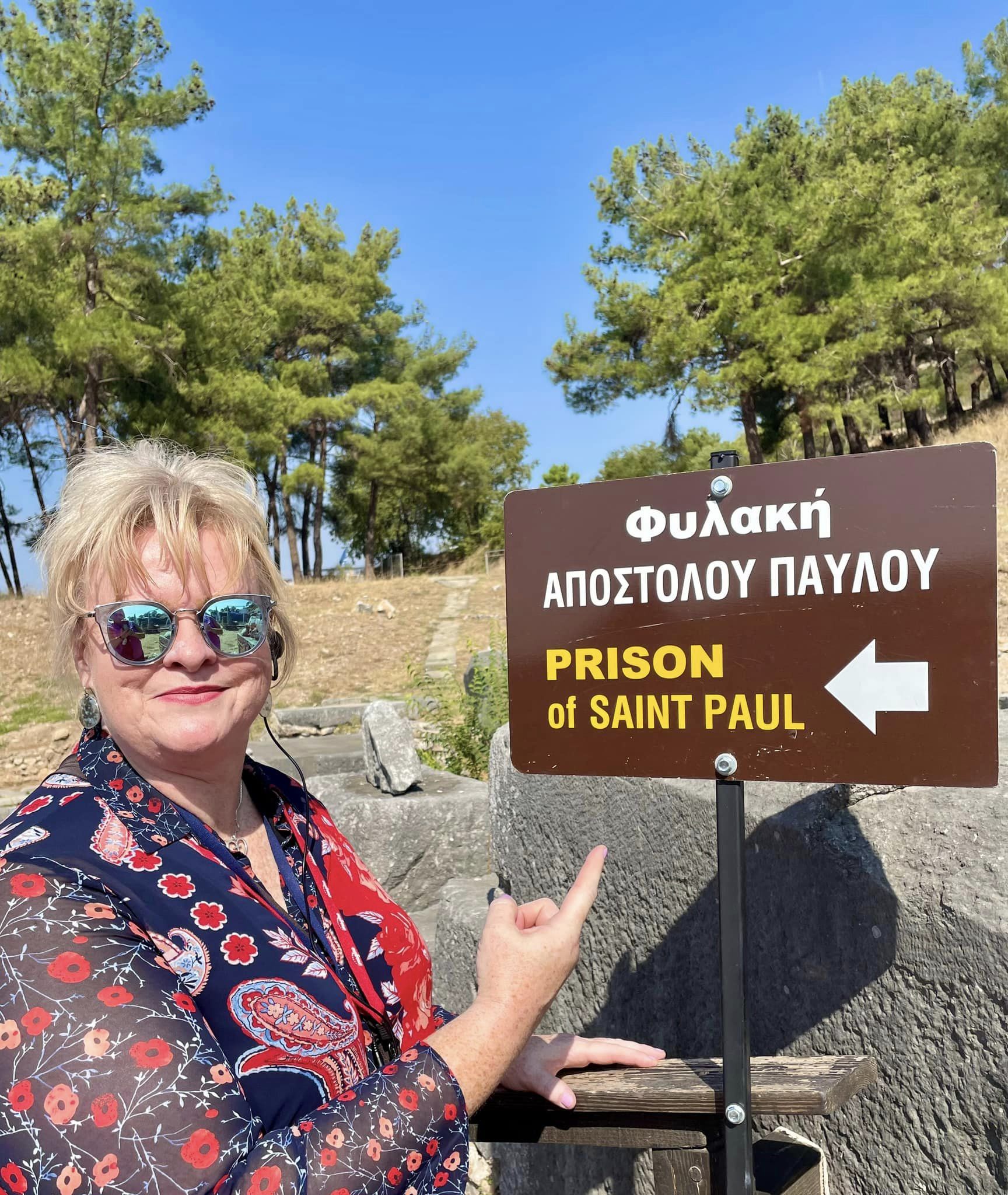
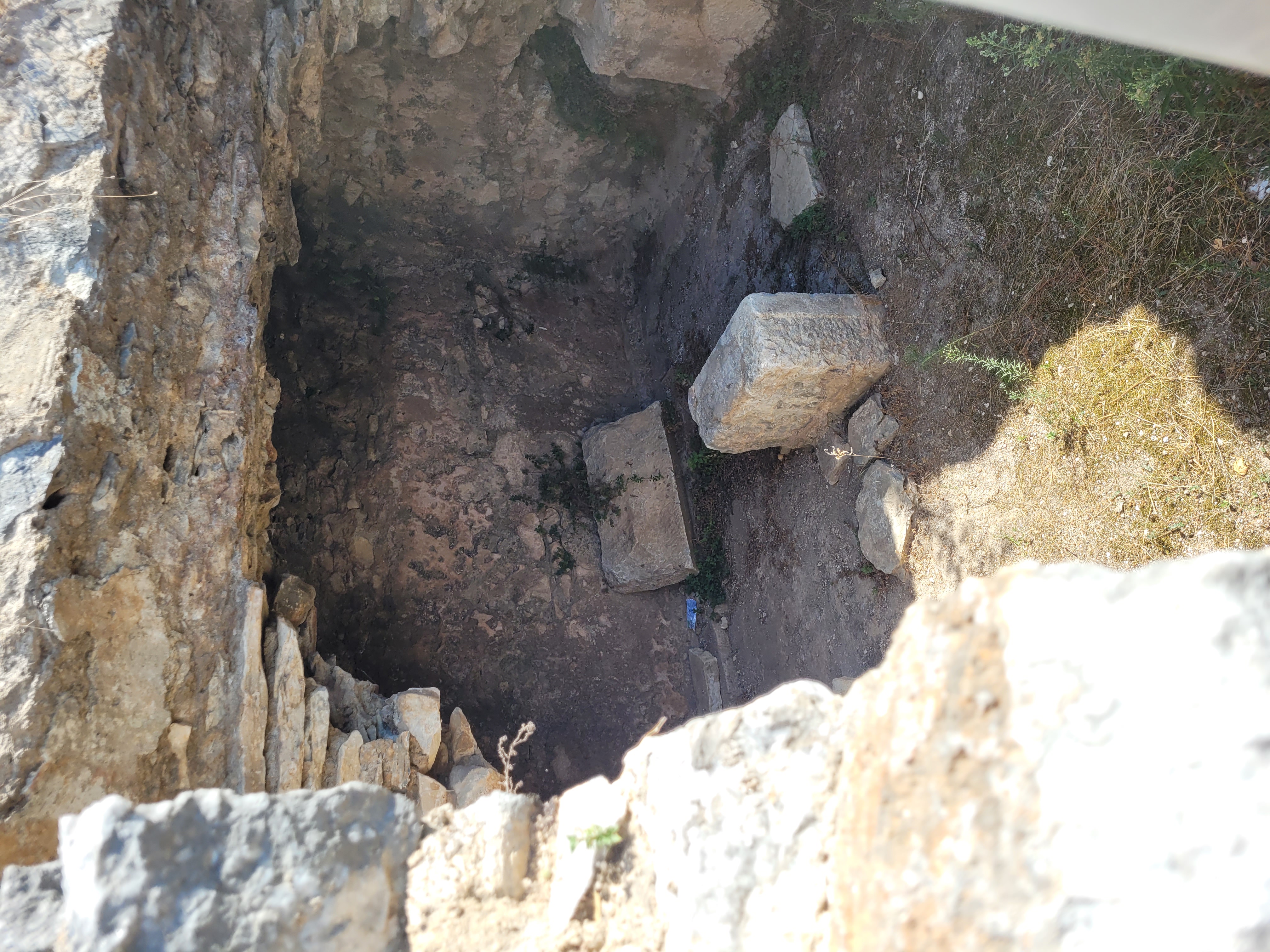
One of the places we visited on our “Footsteps of Paul” tour last month was Philippi. Our dear friend and tour host was Donna Snow, pictured below by the sign of what some believe to be the jail cell where Paul and Silas were held. Our local tour guide told us they were new discoveries by the archaeologists that led them to believe the jail may have been in another part of the town. Whether we were in the exact spot or not doesn’t matter. The events of Acts 16 happened in that town. God’s Word was shared, and by the power of the Holy Spirit, people believed. Did you know that in Greece today, 95% of the population identifies as Greek Orthodox? The vast majority of the Greek population identify themselves as the followers of Christ! And is started with Paul sharing the message of God’s love in Christ in Philippi.

Lord, give me the strength and wisdom to remember that you are always in control. Help me to live with that knowledge today. Amen.
The Jailer2023-10-09T08:06:40-05:00

The Baptism of Lydia

Acts 16:11–15  From Troas we put out to sea and sailed straight for Samothrace, and the next day on to Neapolis. From there we traveled to Philippi, a Roman colony and the leading city of that district of Macedonia. And we stayed there several days. On the Sabbath we went outside the city gate to the river, where we expected to find a place of prayer. We sat down and began to speak to the women who had gathered there. One of those listening was a woman named Lydia, a dealer in purple cloth from the city of Thyatira, who was a worshiper of God. The Lord opened her heart to respond to Paul’s message. When she and the members of her household were baptized, she invited us to her home. “If you consider me a believer in the Lord,” she said, “come and stay at my house.” And she persuaded us.

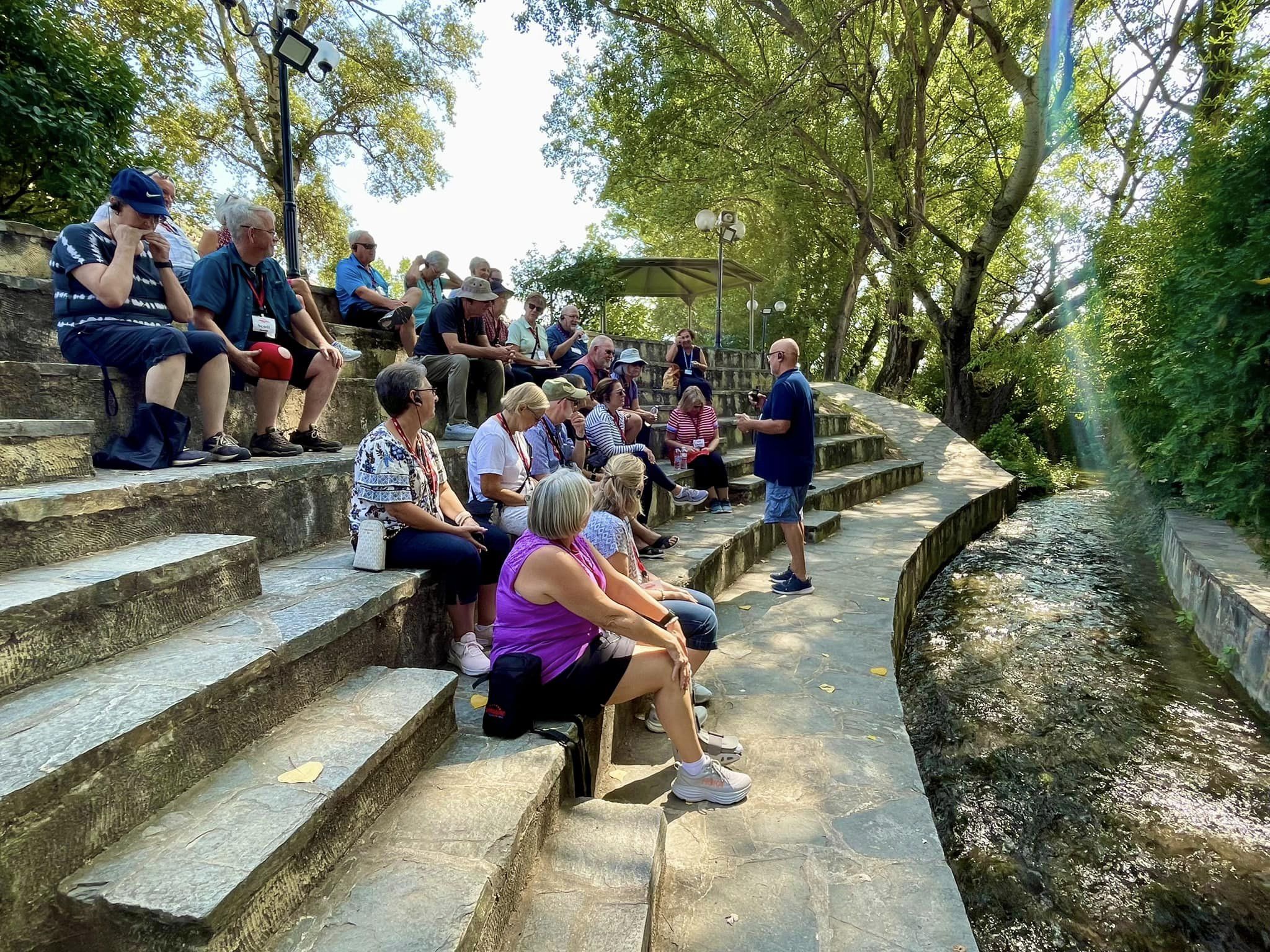
Just a few weeks ago I was standing in some of the places mentioned in this passage: Neapolis and Philippi. I stood beside the river where Lydia was baptized and was able to share some devotional thoughts with our traveling companions as seen in the picture.

Paul went to the river on the Sabbath expecting to find people who worshipped the true God, and he was not disappointed. Lydia was such a person. She was not originally from Philippi, but Thyatira in Asia, which is in modern day Turkey. Lydia was the name of the region where the city of Thyatira was located, so it could have been a nickname for her. Some speculate she may have been either Euodia or Syntyche that Paul mentions near the end of his letter to the church in Philippi, two ladies who were having a bit of a disagreement. But here she is identified as Lydia.

Those of you who know my dear wife, Cheryl, know that she has a little bit of a West Texas accent. When she was attending Concordia Lutheran College in Austin, people would hear her talk and ask, “Where are you from?” and she would say “Vernon.” That became her name on campus. Everyone called her “Vernon.”  I transferred there in the middle of freshman year, and for several months, that is the only way I knew her! Even after I found out her name was Cheryl, I still called her Vernon. It wasn’t until after we started dating during our junior year of college that I started calling her Cheryl.

Getting back to Lydia, she was a prominent businesswoman, and the first convert to Christianity in Europe. When she heard Paul share the news that Jesus was the Son of God and the Savior of all people, the Lord opened her heart. She listened and believed. She and her household were baptized. No matter what her name may have been, she now had God’s name placed on her and would from now on be known has His child.

The Baptism of Lydia2023-10-09T08:08:51-05:00

Macedonian Call

Sometimes the Lord steps into our lives and changes our plans in order to accomplish His purpose. Paul is a great example of this. When Paul was on his way to Damascus to persecute the church, God intervened (Acts 9). He had a greater purpose in mind for Paul.

After Paul’s First Missionary Journey, he thought it would be a good idea to go back to the places where he had established groups of believers to see how they were doing and encourage them. So that is what he set out to do.

Acts 16:6–10 Paul and his companions traveled throughout the region of Phrygia and Galatia, having been kept by the Holy Spirit from preaching the word in the province of Asia. When they came to the border of Mysia, they tried to enter Bithynia, but the Spirit of Jesus would not allow them to. So they passed by Mysia and went down to Troas. During the night Paul had a vision of a man of Macedonia standing and begging him, “Come over to Macedonia and help us.” After Paul had seen the vision, we got ready at once to leave for Macedonia, concluding that God had called us to preach the gospel to them.

Paul thought he should concentrate his missionary activities in the places he had already been. So far, his ministry had been confined to Palestine and Asia Minor. In his first journey, Paul concentrated his efforts around Galatia. As he now began his second missionary journey, logic and common sense suggested that he expand on the work he had already started. After all, he had made a good beginning there. But when he tried to go to Asia, the western province of Asia minor, the Spirit told him not to go there. When he then tried to go to Bithynia, also in Asia Minor, the Spirit once again intervened and said no.  Probably feeling frustrated, Paul went to Troas to wait.  It was there that he had the vision of the man from Macedonia begging come over to Macedonia and help us. This vision convinced Paul that Macedonia was the place to go. That is where God wanted him, rather than where he himself had intended to go.

God’s call to Macedonia through that vision changed the direction of Paul’s life in order to fulfill God’s greater purpose. He was to take the Gospel to new places.  From Troas, a town on the Aegean Sea, Paul would sail over to Macedonia, which was in northern part of Greece. The Good News of Jesus was going to Europe!

Something subtle but interesting is in this passage. Prior to Acts 16:10 Luke used the plural pronoun “they” when talking about Paul and Silas. In verse 10, when speaking is sailing from Troas to Greece, he starts using the pronoun “we.” Luke, the writer of the book of Acts, is now one of Paul’s traveling companions. Together they would proclaim God how God had worked out our forgiveness and eternal life through the life and death and resurrection of Jesus.

Can you think of times in your life in which God had a plan in mind for you that was completely different from your own preferences or wishes? I know this has been true in my life. If someone had told me in the 1983 that the next year I would be serving a congregation in Watonga, Oklahoma, after asking where that was, I would have dismissed it as nonsense. That was not where I saw myself heading. Yet God used me there for a season to share His message and lead those people in a ministry of Word and Sacraments. When I accepted to call to serve Grace Lutheran in Denison, Texas three and a half years later, if someone had told me that would be the place I would stay until I retired, I would not have believed it. But that is how God chose to use me in ministry.

These kinds of things happen in your lives, too.  An unplanned visit to the hospital might give you the opportunity to show your patience in the face of suffering, which may then lead others to inquire about your faith. A missed flight at the airport may give you the chance to confront someone with the need for a Savior. A sudden reversal in your own personal fortune can cause you to realize that God is, after all, in control.  Just as God reached into Paul’s life to accomplish His purpose, so He sometimes reaches into our lives and sends us off in a totally new direction to accomplish His ends.


Macedonian Call2023-10-07T06:37:37-05:00

Timothy and Titus

Acts 16:1–5 [Paul] came to Derbe and then to Lystra, where a disciple named Timothy lived, whose mother was a Jewess and a believer, but whose father was a Greek. The brothers at Lystra and Iconium spoke well of him. Paul wanted to take him along on the journey, so he circumcised him because of the Jews who lived in that area, for they all knew that his father was a Greek. As they traveled from town to town, they delivered the decisions reached by the apostles and elders in Jerusalem for the people to obey. So the churches were strengthened in the faith and grew daily in numbers.

As Paul started to revisit the cities from his first journey, he comes across young Timothy in Lystra. Although his mother was Jewish, his father was not. This was common among Jewish people living outside of Israel. Because Paul wanted Timothy to accompany him on his journey, Timothy was circumcised. Paul knew they would be sharing the Good News with Jewish people, so he did not want Timothy’s lack of circumcision to be an obstacle or barrier to spreading the message of God’s love in Christ.

The irony is that they were sharing “the decisions reached by the apostles and elders in Jerusalem” that is was NOT NECESSARY for Gentiles to be circumcised in order to become followers of Jesus. Was Paul being a hypocrite? Was he succumbing to the pressure of the Jews?

To add to the confusion, when Paul and Barnabas took Titus with them to Jerusalem, they did not have him circumcised, even though the Jews were saying it should be done.

Galatians 2:1–5 Fourteen years later I went up again to Jerusalem, this time with Barnabas. I took Titus along also. I went in response to a revelation and set before them the gospel that I preach among the Gentiles. But I did this privately to those who seemed to be leaders, for fear that I was running or had run my race in vain. Yet not even Titus, who was with me, was compelled to be circumcised, even though he was a Greek. This matter arose because some false brothers had infiltrated our ranks to spy on the freedom we have in Christ Jesus and to make us slaves. We did not give in to them for a moment, so that the truth of the gospel might remain with you.

So why was Timothy circumcised but Titus was not? It was all about freedom. Paul used the freedom we have in Christ to spread the Gospel. He would do whatever it takes, without compromising God’s truth, in order to share Jesus as the Savior of all people. Consider these words God led Paul to write to the church in Corinth.

1 Corinthians 9:20 To the Jews I became like a Jew, to win the Jews. To those under the law I became like one under the law (though I myself am not under the law), so as to win those under the law.

1 Corinthians 10:23–24  “Everything is permissible”—but not everything is beneficial. “Everything is permissible”—but not everything is constructive. Nobody should seek his own good, but the good of others.

Timothy had a Jewish heritage, and fully claiming that heritage would open doors for them as they visited Jewish synagogues to proclaim Jesus. However, in the face of legalistic demands that Greek Titus had to be circumcised, Paul asserted the freedom we have in Christ as the reason not to have Titus circumcised. In both cases, Paul was defending the freedom we have as followers of Jesus.

When Jesus made the payment our sins demanded with by offering His perfect life on the cross, He fulfilled all requirements for us. We do not have to do anything to earn our forgiveness. Our faith simply receives what Jesus earned for us. Any attempt to place other requirements on anyone in order to be saved is a corruption of the Gospel message.

All it takes to be saved it to believe that Jesus died for you, that His death paid for your sins. As a response to that, we will want to try to live a life that pleases God, but that does not earn our forgiveness. It is simply our way of thanking God for His indescribable gift. Don’t let anyone tell you otherwise.

Timothy and Titus2023-10-06T07:36:56-05:00

Time to Go Out Again

After the Council ruling/decision that Gentiles did not have to become Jews in order to be Christians, Paul and Barnabas decided it was time to head out again with the Good News. Their initial thought was to revisit the places they had already been. But there was an issue that would divide them.

Acts 15:36–41 Some time later Paul said to Barnabas, “Let us go back and visit the brothers in all the towns where we preached the word of the Lord and see how they are doing.” Barnabas wanted to take John, also called Mark, with them, but Paul did not think it wise to take him, because he had deserted them in Pamphylia and had not continued with them in the work. They had such a sharp disagreement that they parted company. Barnabas took Mark and sailed for Cyprus, but Paul chose Silas and left, commended by the brothers to the grace of the Lord. He went through Syria and Cilicia, strengthening the churches.

Disagreements do occur among believers. It happened in the early church. It happens today as well. Unfortunately, in our world today, people seem to take the attitude, “If you disagree with me, you are no longer my friend.” That may sound like an oversimplification, but that is often the end result. We don’t know how to disagree without being disagreeable, which many times ruins relationships.

Paul and Barnabas “solved” their conflict by parting company and going their separate ways. They did not view each other as enemies. They both continued the work of sharing the love of God in Christ. Their conflict over John Mark resulted in two teams going out with the Gospel instead of just one. God truly does use all things for good. What follows is the start of Paul’s Second Missionary Journey.

And in case you were wondering, Paul mentions both Barnabas and John Mark favorably in the days ahead in his epistles (1 Corinthians 9:6; 2 Timothy 4:11). The disagreement did not keep them from being brothers in Christ.

Lord, when conflict arises among the faithful, help us remember that we can disagree and still be brothers and sisters in Christ. Help us to strive for unity in Jesus’ name. Amen.

Time to Go Out Again2023-10-04T07:05:25-05:00

Church Council Meeting

When Paul and Barnabas returned from the First Missionary Journey to Antioch, they were telling the people there about all the others who heard the Good News and were following Jesus. We know from Acts 10 and 11 that Peter had also shared the message of Jesus with Gentiles who were now believing and following Him. Then we read this at the beginning of Acts 15.

Acts 15:1 Some men came down from Judea to Antioch and were teaching the brothers: “Unless you are circumcised, according to the custom taught by Moses, you cannot be saved.”

Well-meaning Jewish believers with the best of intentions were trying to place requirements on discipleship that God did not give us. Circumcision was indeed the sign that marked God’s Old Testament people as the ones who would bring the Messiah to the world. But no where does Scripture tell us that it was necessary for those who would follow Jesus.

Paul and Barnabas were sent to Jerusalem to discuss this with the leaders of the church. They shared their stories of Gentiles coming to faith. And in Jerusalem there were those who had the same ideas they heard in Antioch:

Acts 15:5 Then some of the believers who belonged to the party of the Pharisees stood up and said, “The Gentiles must be circumcised and required to obey the law of Moses.”

After some discussion, Peter stood up and gave his testimony.

Acts 15:7–11 “Brothers, you know that some time ago God made a choice among you that the Gentiles might hear from my lips the message of the gospel and believe. God, who knows the heart, showed that he accepted them by giving the Holy Spirit to them, just as he did to us. He made no distinction between us and them, for he purified their hearts by faith. Now then, why do you try to test God by putting on the necks of the disciples a yoke that neither we nor our fathers have been able to bear? No! We believe it is through the grace of our Lord Jesus that we are saved, just as they are.”

We are all saved by grace. A good reminder for us all. Our attempt to live according to God’s Law is our response to knowing we are saved, not the cause of it. If Gentiles wanted to be circumcised to show they were following Jesus, that would be fine, but it was not a prerequisite.

We need to be careful still today to not place a burden on believers that Jesus did not put there. This Church Council Meeting in Acts 15 came to that conclusion, sending a letter to the Gentile believers that encouraged them to live lives that showed their faith without placing any legalistic requirements on them.

One of the men who delivered this letter was a fellow named Silas. More on him tomorrow.

Thank you, Father, for giving me the gift of forgiveness for Jesus’ sake. Help me to rejoice in your grace today. And lead me to respond to Your goodness by living the life to which you have called me as a disciple of Jesus. Amen.

Church Council Meeting2023-10-04T06:24:01-05:00

The First Missionary Journey of Paul (Continued)

Yesterday we started the First Missionary Journey of Paul. It continues in Acts 14 with Paul and Barnabas going to Iconium, Lystra and Derbe. They continued the pattern of preaching to the Jews first and then the Gentiles. People from both groups were putting their faith and confidence in Jesus by the power of God’s Holy Spirit.

In Lystra, God healed a crippled man through Paul (Acts 14:8-10). This led some of the people to assume that they were their gods of mythology. They identified them as Zeus and Hermes, and tried to worship them because of the healing. Paul tried to dissuade them and share the message of God’s love in Christ with them. But the arrival of hostile Jews from the cities where Paul and Barnabas had just been managed to turn the crowd against Paul, and he was stoned and left for dead.

Thankfully, God was not yet done with Paul. He went on to preach in Derbe, and more were led to faith in Christ. Then they went back and strengthened the faithful in the cities they had visited and returned to Antioch to mark the end of this First Missionary Journey.

When I read about the misunderstanding of who Paul and Barnabas were in this chapter, I was struck by the way Christians today are still misunderstood. People on the outside do not understand that Christianity is not just another religion of rules and regulations that you must do to accomplish your own reward. It is all about what God has done for us in Christ.

2 Corinthians 5:19 God was reconciling the world to himself in Christ, not counting men’s sins against them. And he has committed to us the message of reconciliation.

Christianity is not about condemnation, but rescue, salvation and life.

1 Timothy 2:4 [God] wants all men to be saved and to come to a knowledge of the truth.

Christianity is not exclusive, but inclusive.

1 John 2:2 He is the atoning sacrifice for our sins, and not only for ours but also for the sins of the whole world.

Revelation 5:9 And they sang a new song: “You are worthy to take the scroll and to open its seals, because you were slain, and with your blood you purchased men for God from every tribe and language and people and nation.

We need to be sure that we live in a way that shows our faith in Jesus. We know and believe that His death has paid for our sins. We know and believe that His resurrection has opened the way to eternal life for all people. We live with the confidence that we are redeemed, forgiven children of the one true God.

Those on the outside will not understand what Christianity is all about – God’s love in Christ – and we need to be careful not to add to the confusion. Peter, who had his share of missteps and failures,  offers this encouragement to life the new life:

1 Peter 2:12 Live such good lives among the pagans that, though they accuse you of doing wrong, they may see your good deeds and glorify God on the day he visits us.

Lord, help me to live in a way that will show You and Your love to the people I meet today. Amen.

The First Missionary Journey of Paul (Continued)2023-10-03T08:10:50-05:00

Paul’s First Missionary Journey

Acts 13 tells us how what we call “Paul’s First Missionary Journey” begins. It was not Paul’s idea, but God’s. The same one who told the disciples But you will receive power when the Holy Spirit comes on you; and you will be my witnesses in Jerusalem, and in all Judea and Samaria, and to the ends of the earth.” (Acts 1:8) also made Himself known in Antioch.

Acts 13:1-2 In the church at Antioch there were prophets and teachers: Barnabas, Simeon called Niger, Lucius of Cyrene, Manaen (who had been brought up with Herod the tetrarch) and Saul. While they were worshiping the Lord and fasting, the Holy Spirit said, “Set apart for me Barnabas and Saul for the work to which I have called them.”

Paul had been transformed from a persecutor of Christ (Acts 9:4) to one who would make Jesus known among the nations. “Nations” in Hebrew is the same word as “Gentiles,” everyone who was not part of God’s chosen people. Paul would certainly share the Good News of God’s Messiah with his own people, but he would also share it with everyone else, those who were not yet included among God’s chosen people, so that they could become part of the body of Christ.

This was evident from their very first stop on Cyprus

Acts 13:5 When they arrived at Salamis, they proclaimed the word of God in the Jewish synagogues.

A little later, they arrived in Pisidian Antioch, and again went to the synagogue first (Acts 13:14). Paul’s sermon there is a masterful explanation of how Jesus is the fulfillment of God’s promises to save His people. I encourage you to take the time – right now – to read Acts 13:13-43. Go ahead. I’ll wait.

(Imagine me listening to the theme from Jeopardy while you are reading.)

Powerful stuff. I want to highlight this.

Acts 13:38–39 “Therefore, my brothers, I want you to know that through Jesus the forgiveness of sins is proclaimed to you. Through him everyone who believes is justified from everything you could not be justified from by the law of Moses.

Jesus was crucified to pay for the sins of the world. He was raised to conquer death for all people. When you believe in Him you receive the forgiveness and life and salvation He earned. Powerful stuff indeed.

The next Sabbath, a larger crowd gathers, and the Jewish leaders were jealous of all the attention Paul is getting. That is when Paul clarifies that this message is for ALL PEOPLE.

Acts 13:46–48 Then Paul and Barnabas answered them boldly: “We had to speak the word of God to you first. Since you reject it and do not consider yourselves worthy of eternal life, we now turn to the Gentiles. For this is what the Lord has commanded us: “ ‘I have made you a light for the Gentiles, that you may bring salvation to the ends of the earth.’” When the Gentiles heard this, they were glad and honored the word of the Lord; and all who were appointed for eternal life believed.

Gracious Lord, thank you for bringing your salvation to this earth for ALL PEOPLE, so that we could be included in your family. Remind us that we are not to keep it to ourselves, but to share this with those who are still in darkness. Use us to bring people into your marvelous light. Amen.

Paul’s First Missionary Journey2023-10-02T08:16:10-05:00

Miguel

Today I start a month of serving Fishers of Men Lutheran Church in Port Isabel, Texas.  This is my fifth time down here since I retired. It takes us about 11 hours to drive down here from our home. Because we just got back from Greece early Thursday morning, we decided to break this trip up into two days, Friday and Saturday, so that we would not be totally exhausted for the worship service and Bible Study this morning.

On Friday night we went to a small Mexican restaurant for dinner. After we placed our order, I did what I have done hundreds of times before. I asked our waiter his name, and he told me it was Miguel. I said that we were about to ask God to bless our meal and that we would be praying for him as well. Was there anything special he wanted us to pray about?  He paused a moment, and then said, “Yes, there is. I have been trying to get my life back in order. I’ve done some bad things and am putting that behind me. I am hoping to get baptized soon.”  I had already noticed that he was wearing a cross on the outside of his shirt so that others could see it. You could tell he was sincere and excited about turning things around. So Cheryl and I prayed for him.

I was excited to hear about how God was working in this young man’s life. I immediately recalled the week before when we were in Philippi, seeing the places described in Acts 16. This tells us about what we know as Paul’s Second Missionary Journey, during which he had a dream that led him to go to Europe for the first time. The first account we have of European converts to Christianity took place in Philippi: Lydia and the Jailer, along with their households. Take a few minutes today to read Acts 15:36-16:40.

The same one who worked through Paul and Silas is still working through people today to lead others to Jesus. This morning I thanked God for those who have been working in Miguel’s life to lead him to our Savior. I pray that as he is baptized, as God’s name is placed on him with the water, as he joins the family into which Lydia and the jailer and Cheryl and I and all those who have been baptized are a part of, that Miguel will live with the assurance of the forgiveness and life and salvation that Jesus earned is his as well.

God bless each of you on this Lord’s day.

Miguel2023-10-01T04:49:51-05:00

Footsteps of Paul

Yesterday morning, as I was sitting on my riding lawnmower and cutting the grass, I was marveling at the fact that I woke up the morning before that in Athens, Greece. It was almost thirty hours crossing seven times zones from the time of my wakeup call until my head hit the pillow at home, but our travels were all technically on the same day.

Cheryl and I just returned from a “Footsteps of Paul” tour led by Donna Snow where we visited many of the sites of Paul’s Second Missionary Journey. It included three couples we already knew from college and LWML and the congregation I served, but we also made fifteen new friends. It was a wonderful journey on which I was humbled and privileged to lead several devotions and Bible Studies at different sites along the way.

I was even more humbled as I stood in Neapolis, Philippi, Thessalonica, Athens, Corinth and Ephesus and considered what the Apostle Paul had done there. While we had our share of “adventures” on our journey with weather delays and missed connections, we had it easy compared to Paul travelling to those places in the first century. He most likely walked most of the time, was ridiculed, imprisoned and beaten along the way, but he kept going.

Paul had a passion for sharing the Good News of Jesus with everyone he encountered. He did not let the hardships he encountered deter him from his calling. That became even more meaningful as I read the words of Scripture in the places where those things took place. I envisioned Paul standing there, firm in his convictions and daring to speak his faith.

I know that I will be sharing more about this trip with you in the days ahead, but for now I want to pray that I and all of you would have the same kind of zeal and passion Paul did to tell others about Jesus. As I was thinking about all of this I remembered the words Jesus spoke.

John 10:16 I have other sheep that are not of this sheep pen. I must bring them also. They too will listen to my voice, and there shall be one flock and one shepherd.

Paul was trying to bring the other sheep into the fold of the Good Shepherd. We need to do the same in our lives.

Lord, thank you for being the Savior of all people and my Savior. Thank you for paying for the sins of the world and my sin. Thank you for rising on the third day to defeat death and the grave for me and everyone else in the world. Instill in my heart a fervent desire to share your Good News with those who are not yet in a faith relationship with you. May your Spirit use me and my witness to draw more people to faith and forgiveness. I pray this in your holy name. Amen.

Footsteps of Paul2023-09-28T19:34:23-05:00
Go to Top